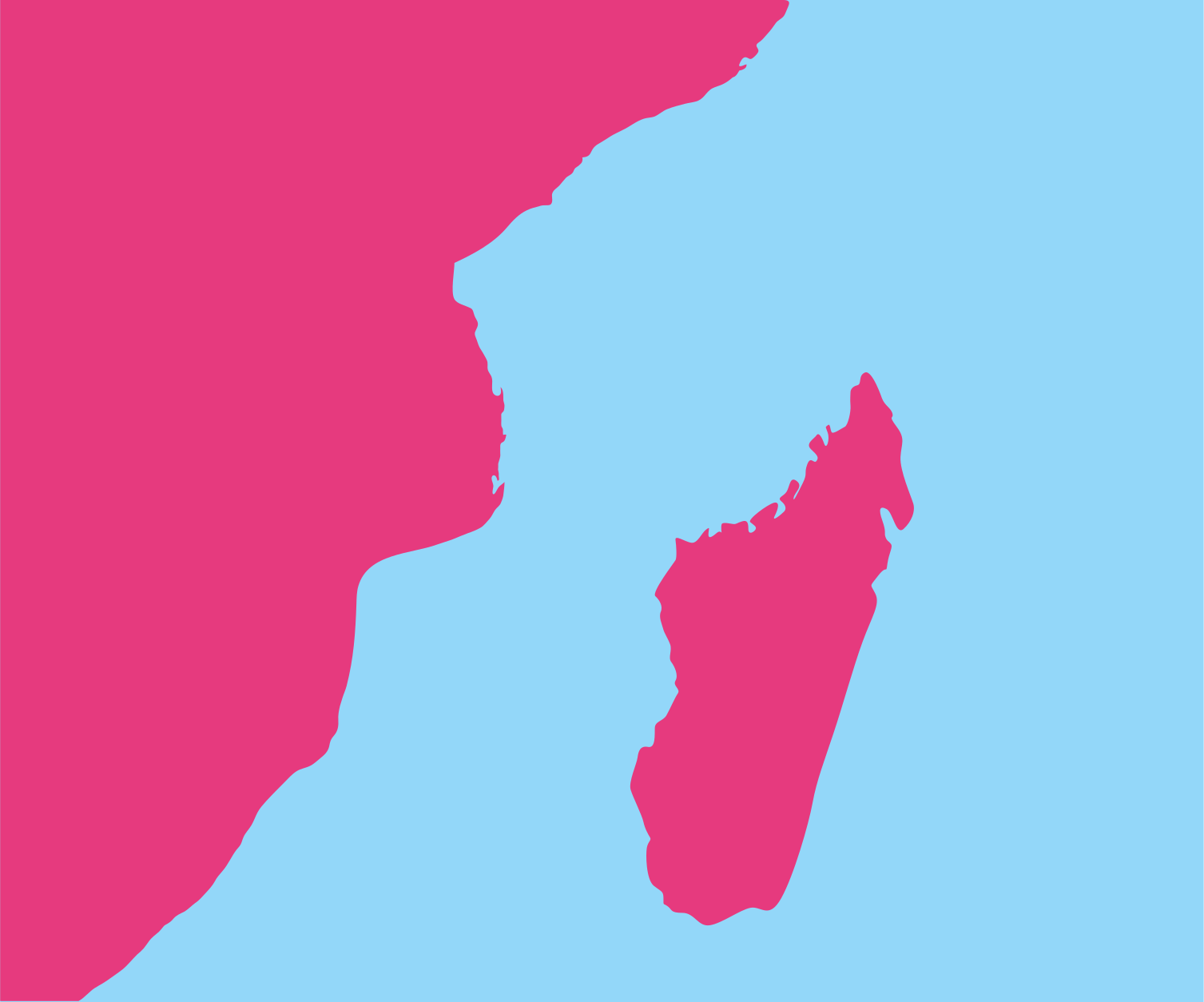
The large island in the South-Western Indian Ocean stretches for nearly 1,600 kilometres from North to South. Crossed by the Tropic of Capricorn at the level of the southern city of Tuléar (or Toliara), the country has an area equivalent to that of France and the Benelux countries combined.
The East Coast, hot and humid, is a land of vast forests and lush vegetation. The West Coast, which is drier, features landscapes of savannah and semi-desert areas in the extreme South. The central Highlands, where the capital is located, are more densely populated and have a more temperate climate.
MADAGASCAR is home to an original flora with a high degree of endemism, although this natural wealth is suffering from the development of human activities.
The unification of the country began with the structuring of the Merina Kingdom in the Highlands, followed by the gradual conquest of the entire territory. After signing a protectorate agreement in 1885, France took control of the country in 1895: MADAGASCAR became a colony. After the Second World War, the country gradually gained autonomy, leading to independence, proclaimed on 26 June 1960.
Philibert TSIRANANA, president of the First Republic, was overthrown by revolutionary movements in 1972. Relations with the former colonial power were quickly severed. In 1975, Didier RATSIRAKA led MADAGASCAR down the path of socialism. The following decade was marked by worsening economic difficulties. President RATSIRAKA was removed from power in 1993, then returned to office in 1997. Marc RAVALOMANANA succeeded him in 2002…
A meeting point of continents, MADAGASCAR has given rise to an original culture, with numerous regional nuances. The fifteen million Malagasy people have predominantly Asian origins in the Highlands and predominantly African origins along the coasts. The Malagasy language has Malayo-Polynesian origins, with more pronounced Swahili influences along the West Coast.
Catholicism and Protestantism, which have been strongly established in MADAGASCAR since the colonial period, have not supplanted traditional beliefs. The influence of Islam is significant in the coastal regions of the North-West.
MADAGASCAR, one of the poorest countries in the world, where more than ten million people live below the poverty line, and where several thousand children live on the streets, with or without their families: 3,000 children have been counted living in the streets, 900 of whom live there permanently. 17% are under 6 years old, 80% are between 7 and 14 years old, and 3% are over 14.
ANTANANARIVO, the city in which we chose to carry out our mission, “mountain capital in a tropical country” as Charles ROBEQUAIN described it, has always fascinated visitors, surprised by the sudden appearance in the distance of the two silhouettes of Manjakamiadana (the Queen’s Palace) and Andafiavaratra (the Prime Minister’s Palace).
The original city, renamed as such in 1510, occupies the hill of Analamanga, an island in the sea of rice fields of Betsimitatatra, a rice-growing plain developed over two centuries by a dynasty of hydraulic-engineering kings.
Since its definitive conquest by King Andrianampoinimerina at the end of the 18th century, the “City of a Thousand” gradually expanded beyond its traditional defensive ditches, spreading over the hills of Faravohitra to the East and Ambohitsorohitra-Isoraka to the West.
Hereditary « Tamboho » belonging to the companions of the great king, or new peripheral districts served by the « ring road »: the capital of MADAGASCAR now has nearly 2 million inhabitants living in its 6 “intra muros” districts, as well as in neighbouring municipalities, inexorably subject to the centripetal dynamics of any metropolis.
At the heart of this picturesque city, steeped in history and renowned for its legendary hospitality, we begin our cooperation mission.